University of Southern California
GameplayQA
A Benchmarking Framework for Decision-Dense
POV-Synced Multi-Video Understanding
of 3D Virtual Agents
Towards Multi-Agent Video Understanding
Why synchronized multi-viewpoint reasoning matters
Many real-world tasks demand reasoning across multiple synchronized viewpoints simultaneously, where Esports and 3D gameplay offer a uniquely controlled testbed for these challenges.
Robot & Autonomous Fleets
Self-driving cars, delivery robots, and surveillance drones share egocentric camera streams to coordinate lane changes, avoid hazards, and plan collectively across agents that each see only part of the scene.
Human Teams
Law enforcement officers wearing bodycams capture the same incident from different angles, requiring cross-pov referencing feeds to reconstruct a coherent timeline.
Sports & Esports Analytics
Broadcast cameras and player POV feeds must be fused to understand formations, predict plays, and generate highlight commentary across synchronized viewpoints.
Reasoning Taxonomy
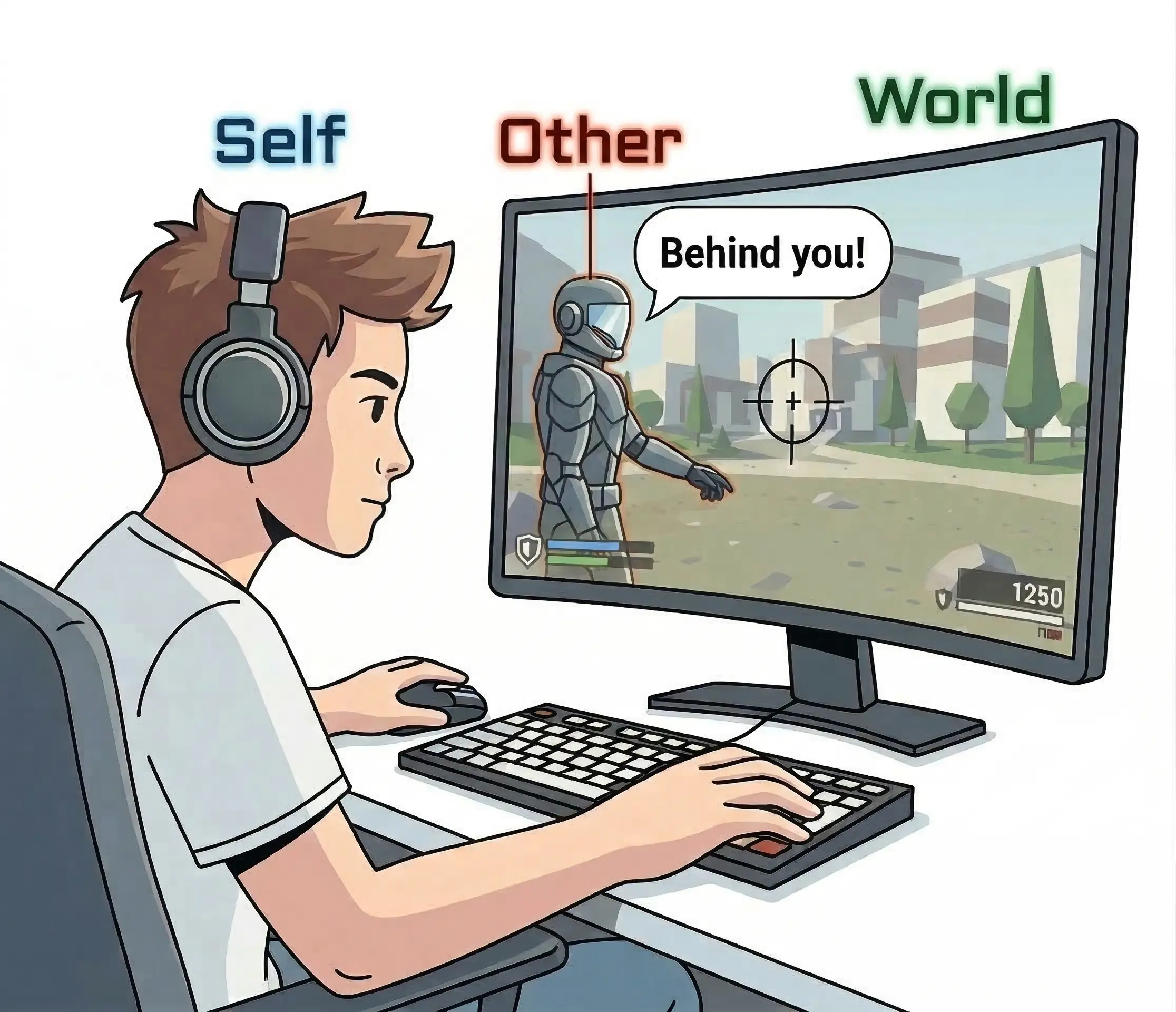
We organize perception around a triadic Self–Other–World entity decomposition. For each entity, we distinguish dynamic and static properties—Action vs. State for agents, Object vs. Event for the world—yielding six primitive label types.
These primitives compose into 15 task categories across three entity perspectives:
- S Self — questions about the agent’s own actions, states, and decisions as seen from its first-person POV.
- O Other — questions about the behavior, intent, and actions of other agents observed in the gameplay footage.
- W World — questions about environmental objects, events, and state changes in the 3D game world.
Annotation Software
We developed a custom multi-track timeline annotation tool purpose-built for dense, synchronized multi-POV gameplay captioning.
Example Questions
Browse diagnostic QA pairs across cognitive levels. Each slide pairs a gameplay video clip with its corresponding question.
Leaderboard
Model performance across task categories. Click any column header to sort. = best, = second best.
| Model | All | ActRec | StaRec | ObjRec | EvtRec | SOC | X-Ent | TsRef | TimLoc | AbsRec | OccCnt | Order | Intent | SyncRef | X-VOrd | POV-ID |
|---|---|---|---|---|---|---|---|---|---|---|---|---|---|---|---|---|
| L1 · Single Reference | L2 · Temporal | L3 · Cross-Video | ||||||||||||||
Error Source Analysis
Fine-grained error analysis across four dimensions reveals that models fail primarily on temporal and cross-video grounding rather than scene-level perception, and that game pace, video length, and number of synchronized perspectives all compound errors.
Error Rate by Distractor Type
Cross-video and temporal distractors cause the most errors
Error Rate by Game
Fast-paced shooters are the hardest
Error Rate by Video Duration
Error increases with video length
Error Rate by Number of Videos
Error scales with number of synchronized videos
Language Prior and Temporal Ablation
To disentangle visual grounding from temporal reasoning, we evaluate GPT-5 Mini under degraded input conditions: no video, a single random frame, and shuffled frames.
| Condition | All | L1 | L2 | L3 |
|---|---|---|---|---|
| Baseline (Full Video) | 62.7 | 67.2 | 61.9 | 60.6 |
| No Video | 29.4 | 36.0 | 29.1 | 24.2 |
| Random Frame | 41.7 | 52.9 | 40.9 | 33.7 |
| Shuffled Frames | 54.8 | 63.1 | 52.6 | 53.4 |
−33.3
No Video vs. Baseline
Language priors alone are insufficient
−21.0
Random Frame vs. Baseline
Static content helps but can’t replace temporal dynamics
−7.9
Shuffled Frames vs. Baseline
Temporal ordering is critical for reasoning tasks
Team

Yunzhe Wang
PhD Student, CS

Runhui Xu
MS Student, CS

Kexin Zheng
PhD Student, CS

Tianyi Zhang
PhD Student, CS

Jayavibhav N. Kogundi
MS Student, CS

Soham Hans
PhD Student, CS

Volkan Ustun
Director, HATS — ICT
Citation
@article{wang2026gameplayqa,
  title={GameplayQA: A Benchmarking Framework for Decision-Dense
         POV-Synced Multi-Video Understanding of 3D Virtual Agents},
  author={Wang, Yunzhe and Xu, Runhui and Zheng, Kexin and
          Zhang, Tianyi and Kogundi, Jayavibhav Niranjan and
          Hans, Soham and Ustun, Volkan},
  year={2026}
}