Abstract
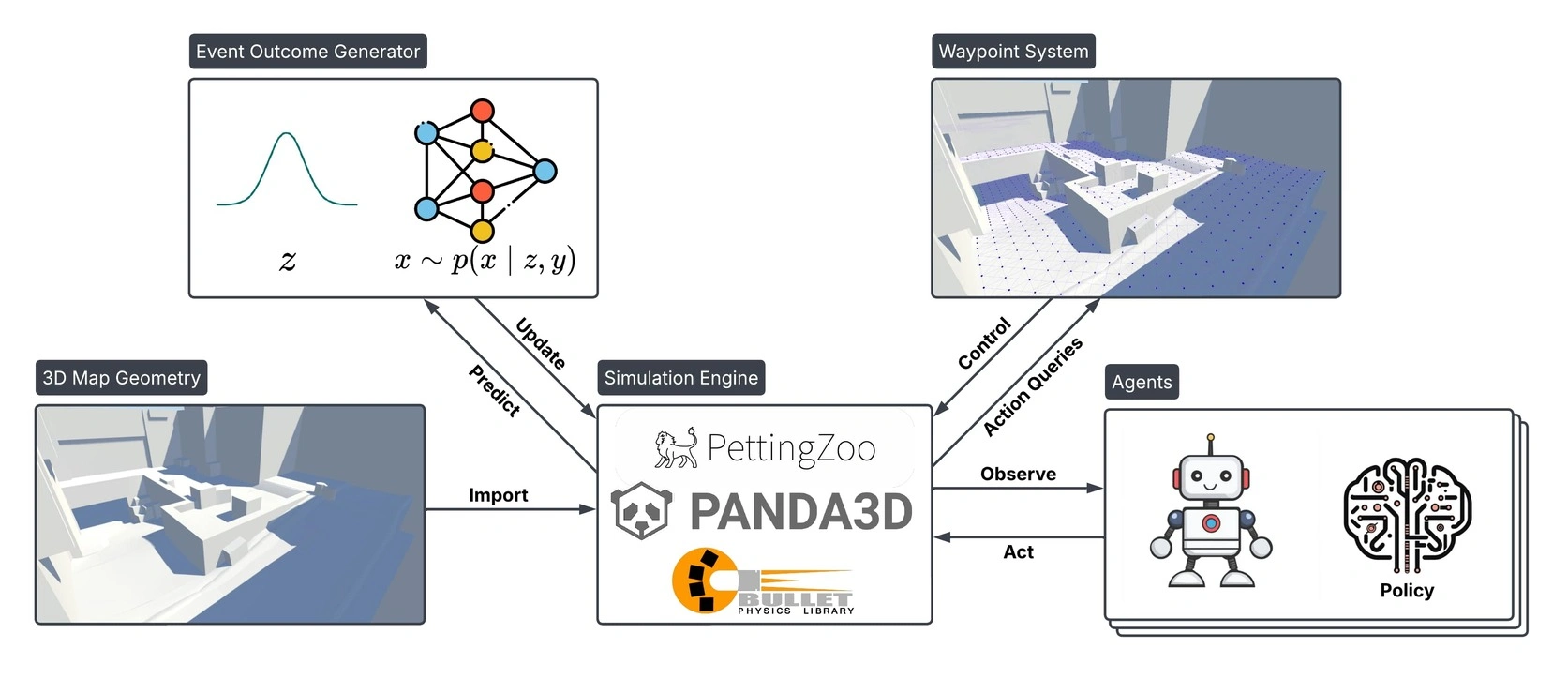
Modern simulation environments for complex multi-agent interactions must balance high-fidelity detail with computational efficiency. We present DECOY, a novel multi-agent simulator that abstracts strategic, long-horizon planning in 3D terrains into high-level discretized simulation while preserving low-level environmental fidelity. Using Counter-Strike: Global Offensive (CS:GO) as a testbed, our framework accurately simulates gameplay using only movement decisions as tactical positioning—without explicitly modeling low-level mechanics such as aiming and shooting. Central to our approach is a waypoint system that simplifies and discretizes continuous states and actions, paired with neural predictive and generative models trained on real CS:GO tournament data to reconstruct event outcomes. Extensive evaluations show that replays generated from human data in DECOY closely match those observed in the original game. Our publicly available simulation environment provides a valuable tool for advancing research in strategic multi-agent planning and behavior generation.
Key Takeaways
1. Bridging High-Fidelity and Computational Efficiency
DECOY addresses a critical challenge in multi-agent research: existing high-fidelity simulators (like StarCraft II and Dota 2) require enormous computational resources for training. By abstracting tactical decisions into a waypoint-based system, DECOY enables efficient simulation without sacrificing strategic realism—making multi-agent planning research more accessible.
2. Data-Driven Event Modeling
Rather than explicitly simulating low-level mechanics like aiming and shooting, DECOY uses neural models trained on real CS:GO tournament data to predict damage events and outcomes. This approach achieves 91% alignment with original match outcomes and 0.961 correlation in health point trajectories—demonstrating that strategic-level simulation can faithfully capture gameplay dynamics.
3. Waypoint-Based State Discretization
The waypoint system transforms continuous 3D environments into navigable graph structures, dramatically reducing the state-action space complexity. This discretization preserves spatial relationships and tactical considerations while enabling efficient planning algorithms—a technique applicable beyond gaming to real-world tactical scenarios.
4. Extensibility to Real-World Domains
While grounded in CS:GO mechanics, DECOY's framework—combining waypoint networks with learned event models—can extend to diverse real-world tactical and strategic domains. With advances in 3D scene reconstruction and motion capture, similar approaches could support research in emergency response, search and rescue, and team coordination scenarios.
High-Fidelity Replay Reconstruction
DECOY demonstrates strong alignment with original CS:GO gameplay across multiple metrics. The simulation achieves:
- 91.0% match outcome alignment with original game results
- 0.961 correlation in health point trajectories over time
- 0.809 correlation in death timing predictions (MAE: 12.8 seconds)
- 2.35 RMSE in health point reconstruction
These results validate that the waypoint-based discretization combined with neural event prediction can faithfully capture the strategic dynamics of complex multi-agent engagements, enabling meaningful research on tactical decision-making without requiring full-fidelity simulation.
Authors



BibTeX
@inproceedings{wang2025decoy,
  title={A Data-Driven Discretized CS:GO Simulation Environment to Facilitate Strategic Multi-Agent Planning Research},
  author={Wang, Yunzhe and Ustun, Volkan and McGroarty, Chris},
  booktitle={Proceedings of the 2025 Winter Simulation Conference},
  year={2025}
}